

BIOMASS BOILER ENGINEERING
Biomass Boiler Fuel Consumption Calculation: Steam & Thermal Oil
Calculate biomass consumption from useful heat duty, as-fired heating value and boiler efficiency. Use fuel data at the moisture condition entering the furnace.
QUICK ANSWER
Fuel use comes from useful duty, as-fired heating value and real operating efficiency.
Use as-fired LHV
Base the calculation on a representative fuel sample at the moisture and ash condition delivered to the plant.
Match the load
Steam production or thermal-oil duty must reflect normal, peak, startup and part-load operation.
State the boundary
Separate boiler efficiency, auxiliary electricity, startup fuel, standby loss and annual availability.
Core formula: biomass fuel (kg/h) = useful heat output (kW) ÷ [as-fired LHV (kWh/kg) × efficiency].
01 · AS-FIRED FUEL DATA
“Wood chips” or “biomass” is not a calculation value.
Obtain a representative fuel analysis: LHV, moisture, ash, volatile matter, fixed carbon, particle size, bulk density and contaminants. For combustion-system selection, include ash-fusion behavior and seasonal variation.
Use LHV at the as-fired moisture content. If the reported value already includes that moisture, do not subtract another evaporation penalty. Match the efficiency to the same LHV or HHV basis.
Fuel moisture and composition vary. A fixed “kg of biomass per tonne of steam” value is valid only for stated steam, feedwater, fuel and efficiency conditions.
02 · STEAM BOILER METHOD
Calculate useful steam duty before fuel input.
For saturated or superheated steam, the useful duty is based on steam mass flow and enthalpy rise from feedwater to outlet steam:
Q (kW) = ṁsteam (kg/h) × [hsteam − hfeedwater] (kJ/kg) ÷ 3,600
Then calculate hourly biomass:
ṁfuel (kg/h) = Q (kW) ÷ [LHV (kWh/kg) × η]
Use enthalpy at the specified steam condition. Include blowdown and auxiliary loads only if they fall outside the stated efficiency boundary.
03 · WORKED 10 T/H EXAMPLE
Illustrative fuel estimate for a 10 t/h biomass steam boiler.
Example assumptions: 10,000 kg/h steam, 2,400 kJ/kg enthalpy rise, 14.0 MJ/kg as-fired LHV and 82% LHV efficiency.
- Useful steam duty: 10,000 × 2,400 ÷ 3,600 = 6,667 kW.
- Convert fuel LHV: 14.0 MJ/kg ÷ 3.6 = 3.889 kWh/kg.
- Fuel input: 6,667 ÷ (3.889 × 0.82) = approximately 2,091 kg/h.
The result is 2.09 t/h at the stated conditions. Calculate annual use from actual load bands and hours, including startup and standby fuel.
04 · THERMAL OIL HEATER EXAMPLE
Illustrative fuel estimate for a 5,000,000 kcal/h biomass thermal oil heater.
For a heater whose stated useful duty is 5,000,000 kcal/h, use the same as-fired LHV and efficiency assumptions:
- Useful duty: 5,000,000 kcal/h × 1.163 W/(kcal/h) = approximately 5,815 kW.
- Fuel input: 5,815 ÷ (3.889 × 0.82) = approximately 1,824 kg/h.
The screening result is about 1.82 t/h. Final selection must also check thermal-oil supply and return temperatures, fluid properties, circulation flow, coil heat flux, furnace volume, grate loading, draft, ash removal and dust collection. Continue with the thermal-oil flow and pipe-size calculation after the heat duty is established.
05 · REAL OPERATING CONSUMPTION
Part load, fuel variation and unburned carbon can move the result.
| Variable | What changes | What to verify |
|---|---|---|
| Moisture and LHV | Available heat per kilogram | Representative seasonal samples |
| Particle size and fines | Feeding, air distribution and burnout | Crusher or screening scope |
| Load factor | Efficiency and auxiliary power | Hourly production profile |
| Excess air and leakage | Stack loss and fan power | Oxygen trend and casing/duct condition |
| Ash and slagging | Heat transfer and availability | Ash chemistry, cleaning and disposal |
| Startup and standby | Fuel used without saleable output | Batch schedule and operating strategy |
For procurement, request a guaranteed fuel-consumption point only after the fuel specification, duty, efficiency basis, ambient conditions and measurement method are agreed. A broad catalog number cannot replace that agreement.
06 · COMBUSTION SYSTEM
The fuel analysis selects more than the boiler body.
Pellets, wood chips, bark, rice husk, palm kernel shell and mixed agricultural residues can require different storage, metering, grate, furnace, air distribution, soot-cleaning, ash-handling and emissions-control arrangements. Low bulk density affects storage and conveyor volume; high moisture affects furnace stability; high ash or difficult ash chemistry affects cleaning and deposit risk.
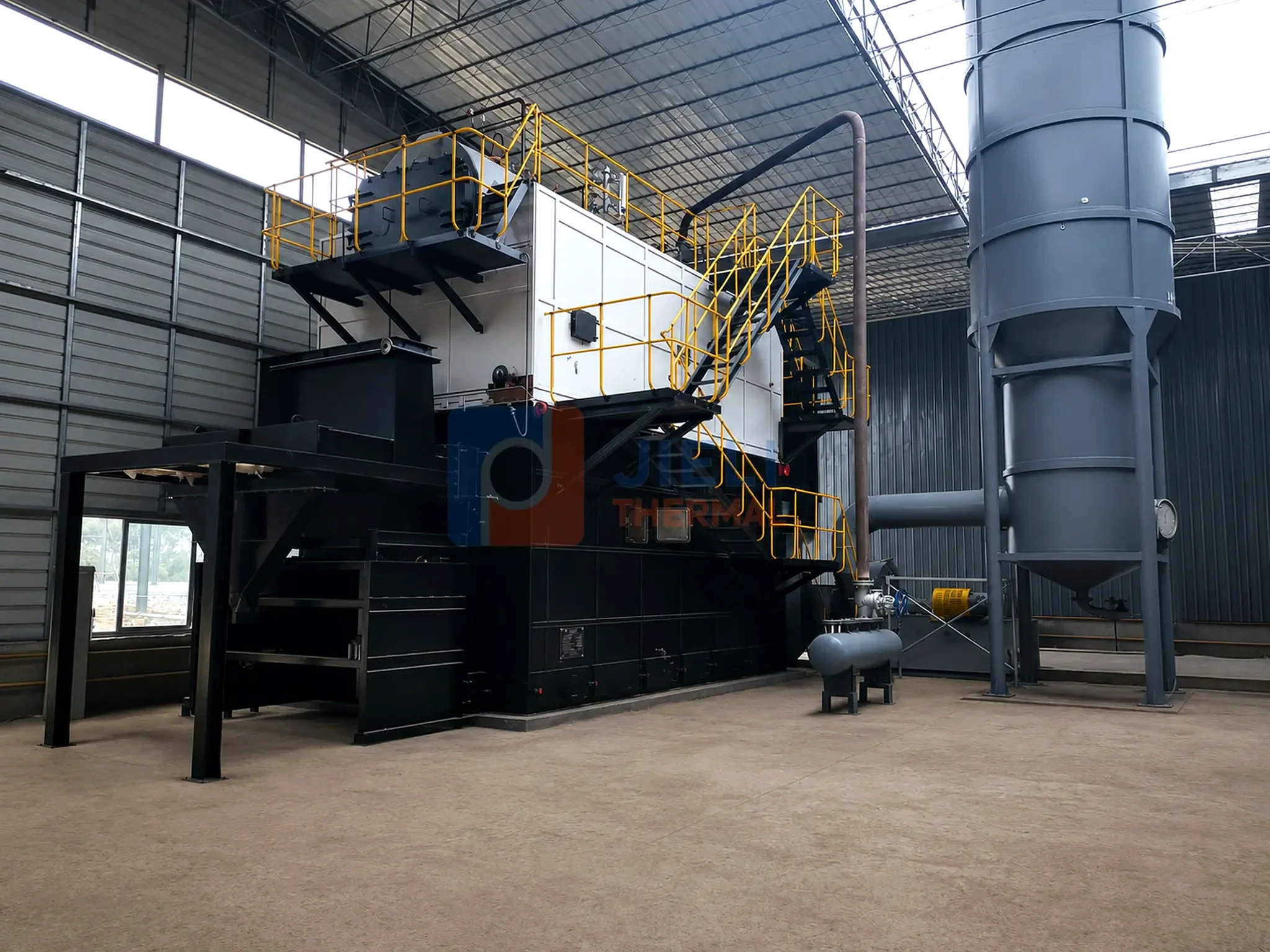
Compare the complete biomass steam boiler system and biomass thermal oil heater system, not only the pressure part. Real export and installed references are shown in JIELI boiler projects.
Data required for a defensible biomass fuel estimate
- Steam flow and pressure, or thermal-oil useful duty and temperature range;
- Normal, peak, startup and minimum load with daily operating hours;
- As-fired LHV, moisture, ash, volatile matter and fixed carbon;
- Fuel particle-size range, bulk density, contaminants and seasonal variation;
- Feedwater temperature, condensate return and blowdown basis for steam;
- Site altitude, ambient conditions, emissions limits and ash-disposal route;
- Agreed efficiency, test standard, measurement boundary and guarantee point.
TECHNICAL REFERENCES
Primary engineering references.
- U.S. EPA — Biomass Combined Heat and Power Catalog of Technologies
- U.S. Department of Energy — Improving Steam System Performance
- JIELI — Steam boiler capacity calculation guide
- JIELI — Fuel-consumption calculation basis
Worked values are illustrative. Final fuel guarantees require a project fuel specification, operating point, test boundary and agreed measurement method.
FREQUENTLY ASKED QUESTIONS
Biomass fuel-consumption FAQ
How do I calculate biomass boiler fuel consumption?
Divide useful heat output by the product of as-fired biomass LHV and boiler efficiency, using consistent LHV or HHV units. For steam, calculate useful duty from steam flow and the enthalpy rise from feedwater to outlet steam.
How much biomass does a 10 t/h steam boiler use?
With an illustrative 2,400 kJ/kg enthalpy rise, 14.0 MJ/kg as-fired LHV and 82% LHV efficiency, the screening result is about 2,091 kg/h. The project value changes with steam condition, feedwater temperature, fuel analysis and efficiency.
Does higher biomass moisture increase fuel consumption?
Usually yes, because as-fired heating value falls and more heat is used to evaporate water. Use a representative as-fired LHV; do not subtract moisture again if the laboratory LHV already includes it.
Can pellets, wood chips and rice husk use the same fuel rate?
No. Their LHV, moisture, ash, bulk density, particle size and combustion behavior differ, affecting fuel mass, storage, feeding, grate, furnace, fans, ash and dust collection.
JIELI THERMAL ENGINEERING
Turn the fuel sample and load profile into a project heat balance.
Send the steam or thermal-oil duty, operating schedule, fuel analysis and site conditions. JIELI can review hourly fuel use, combustion system, auxiliaries and the guarantee basis together.
Request a biomass heat balance