


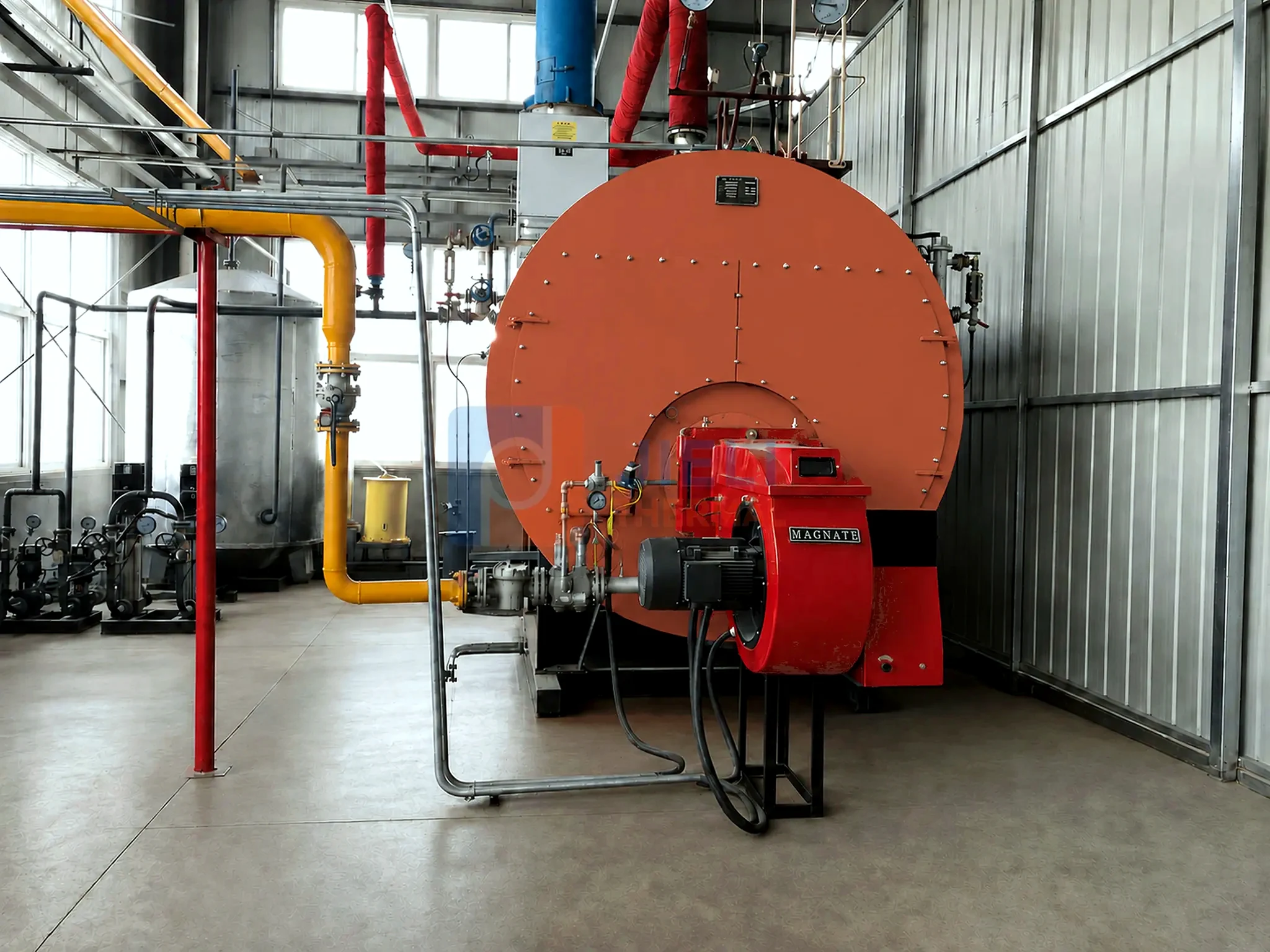
Gas-fired, oil-fired and dual-fuel steam boilers are different systems
A gas-fired steam boiler needs a burner and gas train matched to the approved gas. An oil-fired steam boiler also needs fuel pumping, filtration and any required heating and atomization. A dual-fuel steam boiler needs compatible equipment and a defined changeover sequence for both fuels.
The pressure vessel may be similar across configurations, but the fuel preparation, burner head, valve train, safeguards, emissions strategy and operating procedures are not interchangeable.
1. Data required for a gas burner for a steam boiler
Provide gas composition and pressure range, maximum/minimum steam demand, altitude, air temperature, furnace resistance and emissions limits. Size the gas train for the required flow and pressure loss, with the protection devices required by the applicable standard.
A burner catalogue rating does not prove compatibility. The burner must be matched against the actual furnace pressure and boiler operating range.
2. What changes for an oil-fired steam boiler
Specify liquid-fuel density, viscosity, sulfur, water, ash and heating value. These determine pumping, filtration, atomization and preheating. Heavy fuel oil may also need heated storage, tracing and recirculation.
Where the site uses oil as an emergency backup, confirm fuel ageing, periodic test operation and the time needed to transfer between fuels.
3. When dual-fuel capability is justified
Dual fuel can maintain production during gas interruptions or provide fuel flexibility. Compare that benefit with added storage, conditioning, controls and maintenance.
- Define the normal fuel and backup fuel.
- Confirm whether changeover is manual, supervised or automatic.
- Check whether the steam load can be maintained during transfer.
- Confirm storage duration and liquid-fuel conditioning.
- Test both fuel modes during commissioning and periodic maintenance.
4. Turndown and load profile matter more than peak capacity alone
Repeated operation below stable minimum firing causes cycling. Record normal, minimum, peak and startup steam demand; check burner turndown together with boiler water volume and controls.
For capacity methodology, use the industrial steam boiler selection guide. For system interfaces, review the steam boiler system and piping diagram.
Worked example: why a 6 t/h peak is not enough to select a burner
Consider an illustrative factory with a 6 t/h short peak, 4 t/h normal production and 0.8 t/h overnight steam demand. Its peak-to-minimum steam-load ratio is 6 ÷ 0.8 = 7.5:1. This is a demand-screening ratio, not a specified burner turndown ratio: actual fuel input also depends on steam conditions, feedwater and heat losses.
- Request the operating envelope: ask the supplier to confirm stable minimum output for the proposed boiler and burner combination, not just the burner’s catalogue maximum.
- Check both fuels: a dual-fuel proposal must state the available operating range and performance basis separately for gas and backup oil.
- Review the overnight duty: if demand falls below the stable range, compare operating schedules or multiple-boiler arrangements with the designer. Do not assume a larger boiler solves low-load cycling.
Prepare the load schedule with the steam boiler capacity calculation guide and Bosch’s steam consumption planning guidance. The example demonstrates load-range selection; it is not a performance guarantee.
5. Combustion safeguards and boiler controls
Verify water level, fuel and air conditions, purge, ignition and flame detection through the specified burner sequence. Trips must shut off fuel and identify the initiating fault. Check air/fuel coordination throughout modulation.
Local codes and the selected burner supplier determine the exact devices and sequence. Final engineering must be reviewed for the project jurisdiction.
6. Compare complete supply boundaries, not boiler shells
Compare boiler, burner, fuel train, fans, controls, feedwater, treatment, economizer, condensate and blowdown equipment, stack, instruments, commissioning and spares on the same supply boundary.
See the current JIELI gas-fired and oil-fired steam boiler range, including preliminary WNS model data, burner regulation and auxiliary-system options.
Project information to send for a proposal
- Required steam capacity, pressure, quality and operating schedule
- Minimum, normal and peak steam demand
- Natural-gas composition and available pressure, or liquid-fuel analysis
- Feedwater temperature, water analysis and expected condensate return
- Project country, altitude, ambient conditions and electrical supply
- Emission limits, inspection code and documentation requirements
- Required supply boundary and preferred normal/backup fuel arrangement