

1. Identify every steam user and steam-quality requirement
Food plants may use steam in jacketed cookers, blanchers, retorts, dryers, bottle or package washing, CIP heat exchangers and hot-water generation. Direct culinary steam or clean-steam duties have different treatment, material and contamination-control requirements from plant utility steam.
The responsible process and food-safety teams must classify each use. A conventional industrial boiler should not be assumed to produce culinary, clean or pure steam without the required water treatment, filtration, separation and applicable hygienic design.
2. Calculate capacity from the operating schedule
Prepare a list of continuous, batch, warm-up and cleaning loads. Record steam flow, required pressure, operating duration and whether users run together. Include line-startup peaks and the timing of CIP rather than simply adding all equipment nameplates.
- Normal, minimum and peak steam flow for each process line
- Required pressure at each user and estimated distribution pressure loss
- Batch cycle, warm-up time, shift pattern and simultaneous-operation factor
- Feedwater temperature and expected condensate-return percentage
- Planned production expansion and required standby philosophy
- Project code, fuel data, emissions limits and site conditions
See the steam boiler capacity calculation guide for a transparent preliminary method.
3. Select fuel, boiler arrangement and operating range
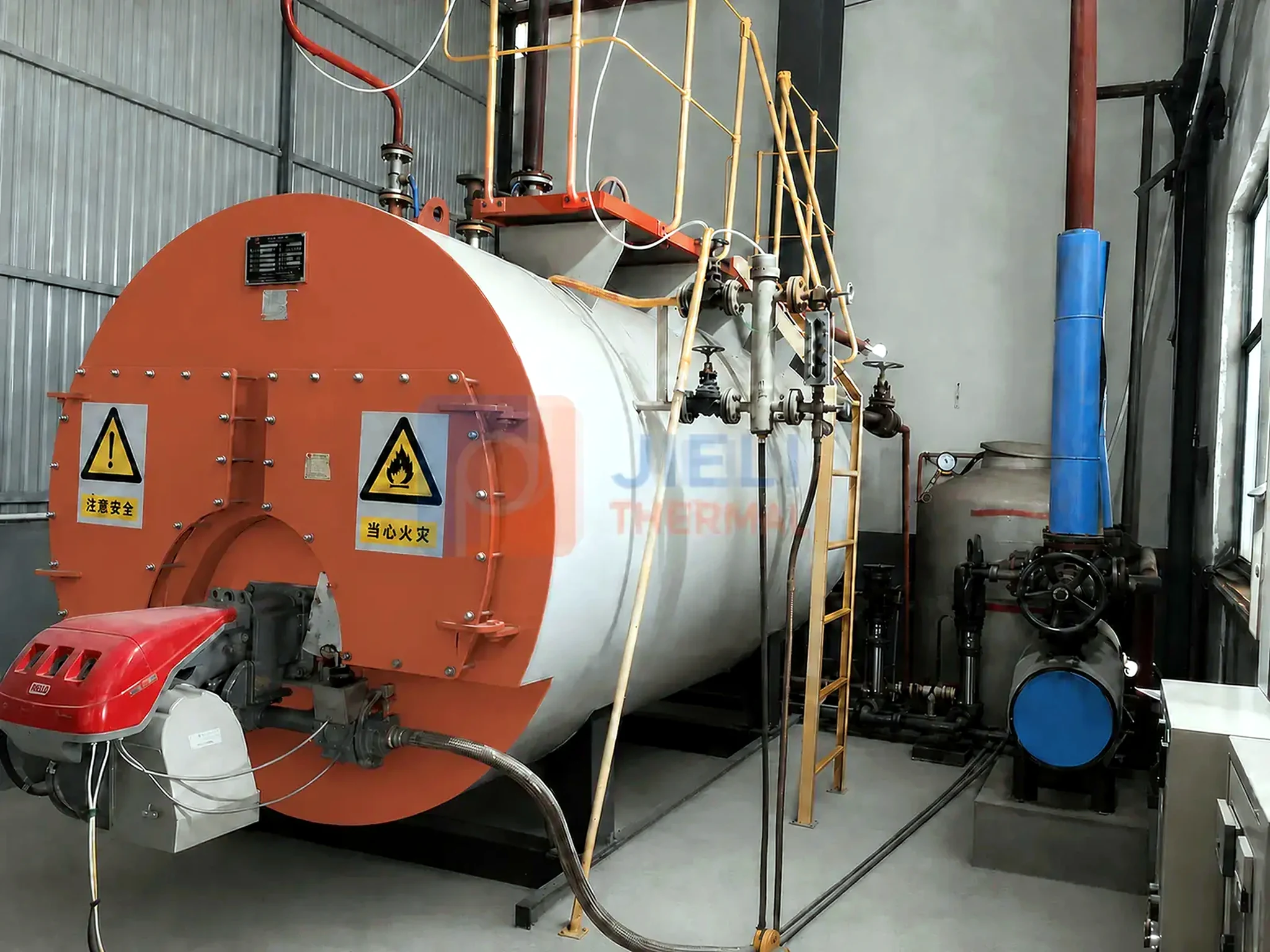
Start with the JIELI industrial steam boiler range to compare published capacities and pressure options against your food-plant demand. A gas- or oil-fired steam boiler is often evaluated where automatic operation, modulation and compact packaging are important. A biomass-fired steam boiler can be considered where a stable fuel supply, storage space, ash handling and suitable emissions controls are available.
Normal and minimum load matter as much as the peak. Burner turndown, boiler water volume, multiple-boiler staging and standby requirements affect how the plant responds to batch production. Review the gas, oil and dual-fuel burner selection guide when fuel resilience is required.
4. Water treatment and condensate recovery
Raw-water analysis determines the treatment process. Hardness, alkalinity, silica, dissolved solids and oxygen can affect scale, corrosion, blowdown and steam quality. The treatment supplier, boiler supplier and plant operator should agree the feedwater and boiler-water limits, test schedule and chemical program.
Returning clean condensate can recover heat and treated water, but every return stream must be assessed for contamination risk. Suspect condensate should be monitored, diverted or handled according to the plant’s food-safety plan. The feedwater tank, deaeration approach, pumps and return temperature are part of boiler-system sizing.
5. Complete steam-system scope
A complete supply review may include the boiler, burner and fuel train, feedwater tank and pumps, water treatment, economizer, steam header, separator, pressure reduction, condensate recovery, blowdown equipment, stack and control system. Follow the flow on the industrial steam boiler system and piping guide.
Insulation, drainage, steam traps, header velocity, water-hammer prevention and maintenance access are field-engineering responsibilities. Local pressure-equipment and food-production requirements determine the final arrangement.
6. Data for a food-processing boiler RFQ
Send the steam-user schedule, process pressure, feedwater and condensate data, fuel specification, site utility standard, plant layout and required supply boundary. State any culinary-steam, clean-steam or hygienic-interface requirement explicitly so it is not confused with general utility steam.
Also identify installation responsibilities, local inspection, documentation language, commissioning support, spare parts and the production downtime available for connection.