


Short answer: the names usually describe the same system
Looking for equipment rather than terminology? Compare the thermal oil heater range, fuel options and specifications, or review gas-fired thermal fluid heater model data.
A thermal oil heater heats circulating oil for indirect process heating. Thermal fluid heater is broader: it can use mineral oil, synthetic or other heat-transfer fluids, and some designs operate in vapor phase. Thermic fluid heater is another established term. Hot oil boiler commonly means a liquid-phase heater in which the oil does not boil.
This article concerns closed-loop liquid-phase systems. State that operating mode and the required fluid, duty, supply/return temperatures, flow, fuel and supply scope.
Why buyers use three different names
“Thermal oil heater” names the usual medium; “thermal fluid heater” allows other fluid chemistries; “hot oil boiler” is the common boiler-market term.
The name does not specify construction or fuel. Gas-fired, electric and biomass heaters need different heat sources, controls and auxiliaries.
Where “thermic fluid heater” is used
Thermic fluid heater is common in Indian and South Asian equipment literature. Thermal fluid heater and thermal oil heater are also established terms. Confirm the operating mode rather than relying on the name.
Compare duty, temperatures, fluid, flow and supply scope in the thermal oil heater and thermal fluid system range.
Choose the equipment route for your process
- Gas-fired thermal fluid heater or oil-fired thermic fluid heater: specify fuel properties and burner duty.
- Biomass thermic fluid heater for plywood or textiles: specify fuel moisture, ash and process temperature.
- 2,000,000 kcal/h thermal oil heater, 5 MW thermal fluid heater or 10 MW hot oil boiler
- Thermal fluid heater for asphalt tank heating, chemical reactor heating or palm-oil processing
Choose the fuel and application first, then check the model data and supplied equipment. Compare the gas and oil-fired heater, biomass heater, asphalt and bitumen heating solution and chemical-process heating solution.
What a thermal fluid heater does
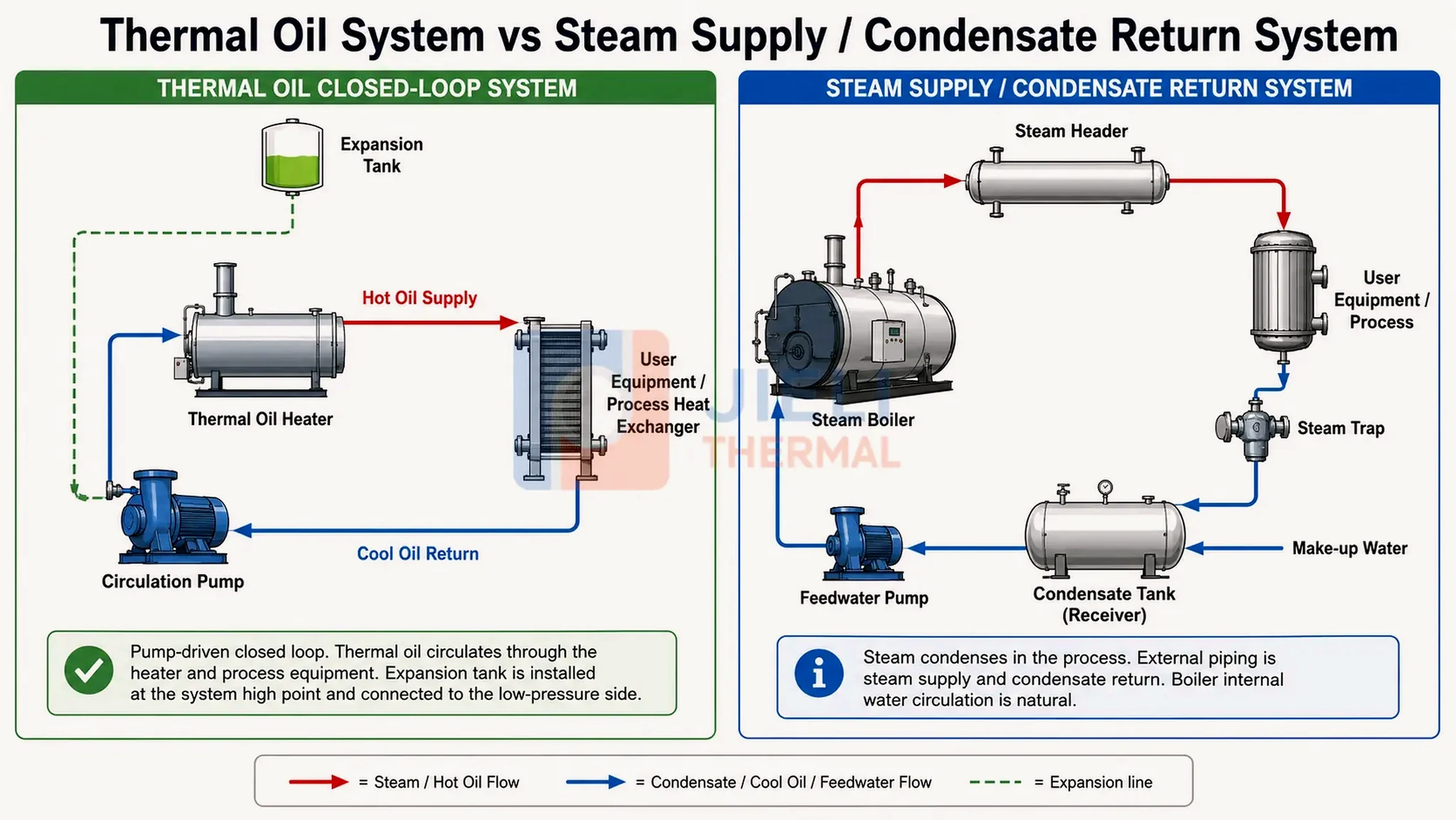
The heater adds energy to the circulating fluid. A pump moves the fluid through the heater coil and onward to the process. After transferring heat, the cooler fluid returns to the heater. An expansion and deaeration arrangement accommodates temperature-related volume change and supports stable circulation. Storage, filtration, heat recovery, nitrogen blanketing, controls and emergency cooling may be considered according to the fluid and process.
Because many organic heat-transfer fluids can deliver high process temperatures while remaining in the liquid phase, the loop can avoid the saturation pressure associated with steam at the same temperature. This does not make the system automatically safe or simple. Film temperature, flow velocity, pump suction conditions, oxidation, contamination, expansion volume, leakage risk and shutdown logic require disciplined engineering.
Thermal oil heater versus industrial steam boiler
A thermal oil heater distributes indirect heat through a circulating liquid, whereas an industrial steam boiler supplies steam. The names alone do not decide which medium the process needs. Use the thermal oil heater vs steam boiler engineering comparison for temperature, direct-contact use, water treatment and operating-cost considerations.
Steam systems require feedwater preparation, boiler-water control, blowdown, steam distribution, traps and condensate management. Thermal-fluid systems require fluid compatibility checks, circulation and expansion engineering, film-temperature control and fluid-condition monitoring. The better choice follows the process users, temperature level, site utilities and operating team rather than a universal efficiency claim.
Fuel options do not change the terminology
A thermal fluid heater may use natural gas, LPG, diesel, fuel oil, biomass, coal, electricity or recovered heat where the design supports it. Gas and liquid-fuel burners can offer compact automatic operation. Biomass and coal systems add fuel storage, conveying, furnace, ash and particulate-control requirements. Electric heaters eliminate on-site combustion but depend on available electrical capacity and energy economics.
For gas, diesel or fuel-oil projects, review the JIELI gas/oil-fired thermal oil heater. The product page lists preliminary model data, equipment photographs and supply options. Solid-fuel projects should begin with representative fuel analysis rather than a generic fuel name.
What to specify before requesting a quotation
- Required process heat duty and normal, minimum and peak load
- Thermal-fluid name, manufacturer data sheet and current condition where applicable
- Required supply and return temperatures and maximum allowable film temperature
- Process-user pressure drop, piping distance, elevation and layout constraints
- Fuel composition, pressure, temperature, availability and backup-fuel requirement
- Project country, altitude, ambient range, power supply and emissions limits
- Required design, inspection, documentation and certification basis
- Supply boundary: heater only, packaged skid or complete thermal-fluid system
These inputs support heater duty, coil design, circulation flow, pump head, expansion volume, burner or combustion selection, control philosophy and auxiliary scope. A model number without this project basis is not a complete technical proposal.
How terminology varies across international projects
English-language documents in Pakistan, Australia, the Middle East, Africa and Southeast Asia may use thermal oil heater, thermal fluid heater, hot oil heater or hot oil boiler interchangeably. Spanish-speaking buyers in Chile and Argentina often search for “caldera de aceite térmico” or “caldera de fluido térmico.” Brazilian projects may use “aquecedor de óleo térmico” or “caldeira de fluido térmico.” Russian, Arabic, Indonesian, Vietnamese and Thai projects have their own local purchasing terms.
The localized international boiler project pages provide local-language starting points. Confirm the destination’s design, inspection and installation requirements in the project specification.
How to compare a China boiler manufacturer
For a thermal fluid heater or steam boiler, compare the manufacturer’s engineering scope, pressure-part and coil fabrication, material traceability, welding controls, non-destructive examination, testing, burner or combustion matching, controls, documented supply boundary and export preparation. Ask for the production and inspection records relevant to the equipment being quoted.
Review the JIELI China boiler manufacturing base for workshop photographs and the buyer due-diligence checklist. Then send the same project data to each bidder so technical differences can be separated from simple scope omissions.
Frequently asked terminology questions
Is a thermal oil heater a boiler?
It is often sold within the industrial boiler market, but most thermal-oil systems heat and circulate a liquid without boiling it. The exact regulatory classification depends on equipment construction and the applicable jurisdiction.
Is a thermal fluid heater safer than a steam boiler?
It can deliver high temperatures at lower system pressure than saturated steam at the same temperature, but it introduces different hazards such as combustible-fluid leakage, degradation, low-flow overheating and expansion-system problems. Safe operation depends on correct design, safeguards, maintenance and trained operators.
Can an existing hot oil system use a different thermal fluid?
Not without an engineering review. Fluid chemistry, viscosity, temperature limits, compatibility, cleaning requirements, pump duty, seals, expansion volume and control settings may change.
Which keyword should be written in an RFQ?
Use the term familiar to your team, then state that the project is a closed-loop liquid-phase process-heating system. Include the measurable operating data and the required supply boundary. That removes ambiguity regardless of whether the heading says thermal oil heater, thermal fluid heater or hot oil boiler.